SAP Error: Account Determination for Entry LNER GBB ___ BSA Not Possible
This error means SAP can't find a G/L account mapped for the combination of valuation grouping code, transaction key GBB, general modification BSA, and the material's valuation class - typically surfacing during an initial stock entry posting. This guide covers both fixes from the original solution (OBYC for the missing account, OMWD for the valuation grouping code assignment), then goes deeper into what BSA specifically represents and how it differs from other GBB scenarios. If you encounter any errors in SAP, feel free to send a screenshot to pramod@learntosap.com for help.
✅ Account Determination for Entry LNER GBB ___ BSA Not Possible
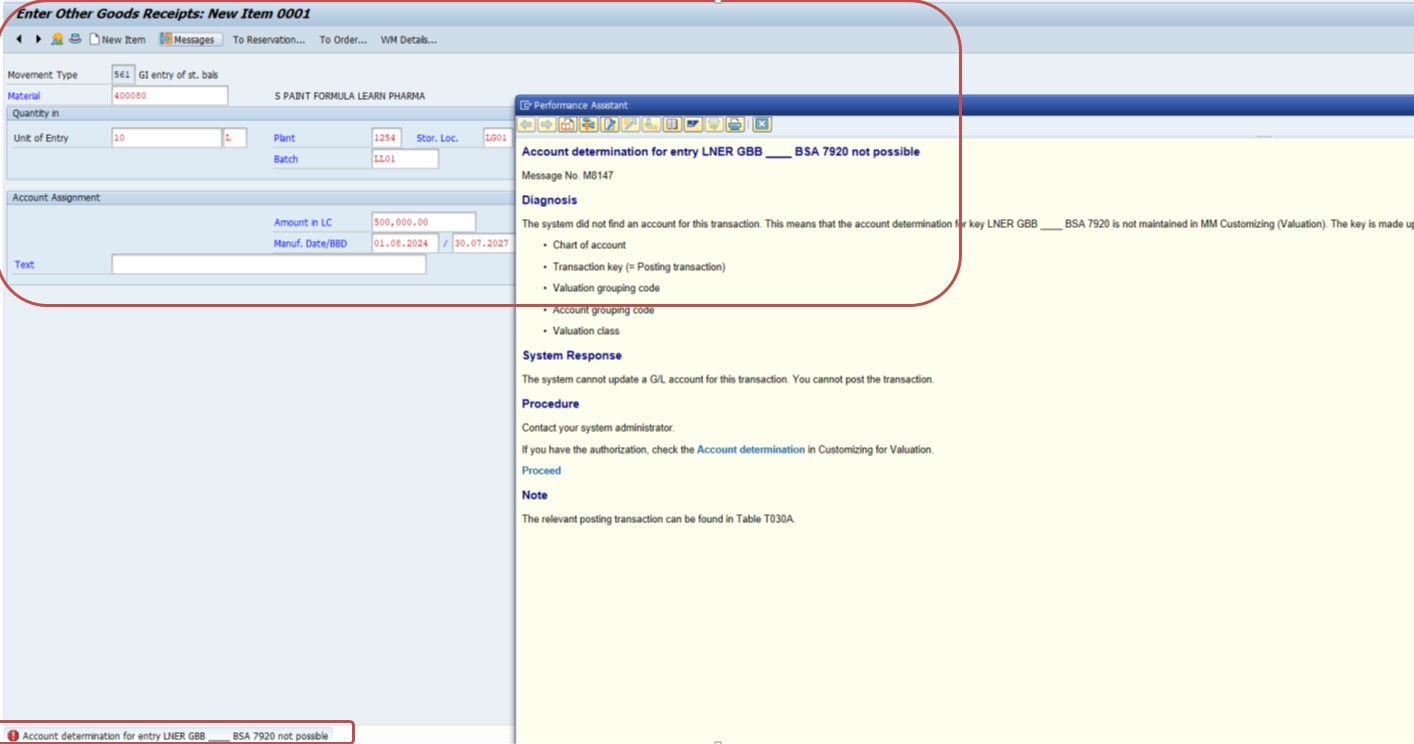
This error message usually indicates that the system cannot find the correct General Ledger (G/L) account to post to for a specific transaction, or that the account determination for the valuation area assignment itself is incomplete.
🔧 Solution 1: Check the Transaction Key (GBB) Configuration in OBYC
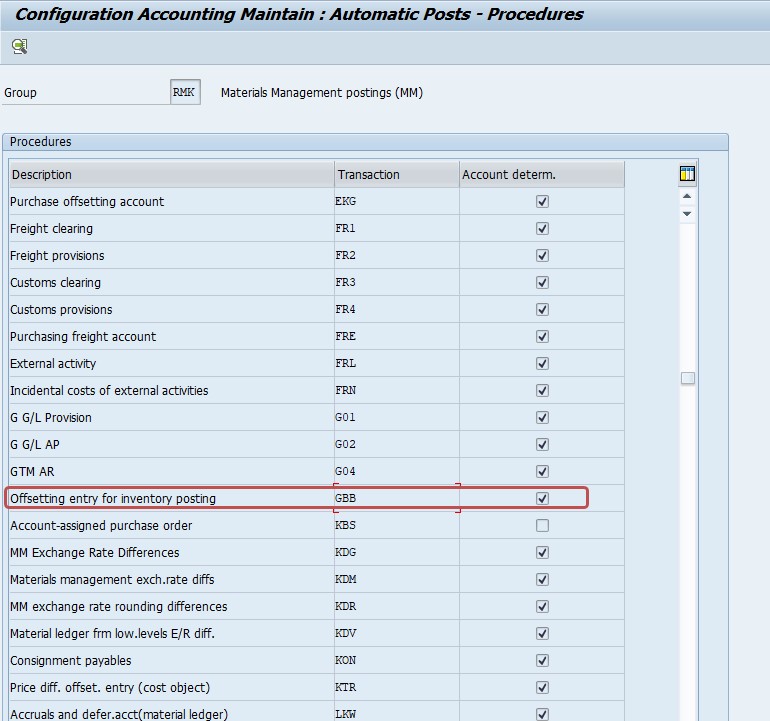
GBB is the transaction key for account determination in SAP related to goods issue and other stock movements.
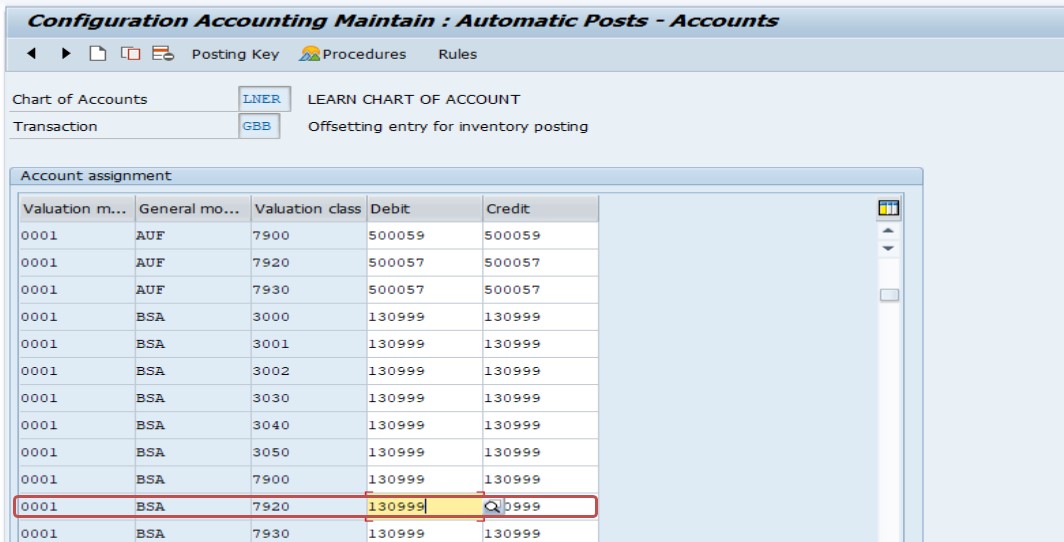
Go to transaction OBYC (Automatic Account Determination) and check the settings for GBB.
Ensure the correct G/L account is assigned under general modification BSA. Check that the G/L account code isn't missing - for example, account 130999.
🔧 Solution 2: Confirm Valuation Grouping Code Assignment in OMWD
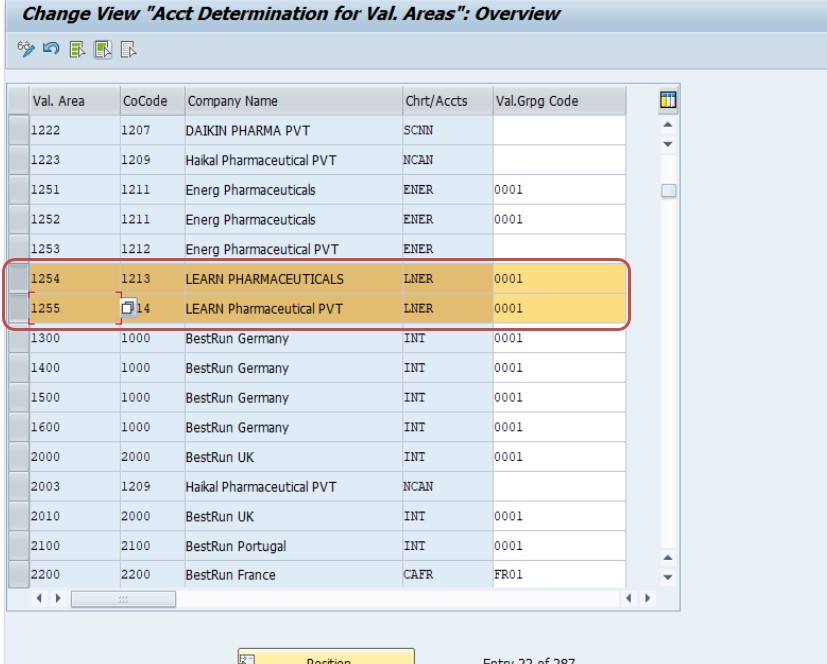
OMWD is the transaction used to configure "Default Values for Goods Movement" under the Inventory Management module - including which valuation grouping code applies to a given valuation area (plant) and company code combination.
In OMWD, confirm the assignment for each relevant valuation area - for example: Val. Area 1254, Co. Code 1213, Company Learn Pharma, Chart of Accounts LNER, Val. Grpg Code 001; and Val. Area 1255, Co. Code 1214, Company Learn Pharma, Chart of Accounts LNER, Val. Grpg Code 001.
Save.
🔍 What General Modification BSA Actually Represents
Transaction key GBB is split into several "general modifications," each covering a distinct offsetting-entry scenario, and BSA specifically covers initial stock entry - creating stock for a material for the first time, typically via movement type 561, without any reference to a purchase order. This is common during a new material's go-live, an opening balance load, or a correction where stock genuinely needs to be created from scratch rather than received against a purchasing document.
Because BSA covers this specific, somewhat less-routine scenario, it's easy for it to be overlooked during initial OBYC setup if the configuration team focused primarily on the more frequent day-to-day postings (like VBR for consumption or WRX for GR/IR clearing) - exactly the kind of gap this error surfaces the first time someone actually attempts an initial stock entry for a material under an incompletely configured valuation class or grouping code.
📋 Why OMWD Matters Even When OBYC Looks Correct
It's possible for OBYC's G/L account mapping to be entirely correct for a given valuation grouping code, and this error to still occur - if the specific plant (valuation area) involved in the failing transaction isn't actually assigned to that valuation grouping code in OMWD in the first place. In that case, OBYC is being checked against the wrong (or no) grouping code entirely, since the plant's actual assignment doesn't match what the configuration team assumed.
This is precisely why the original fix for this error includes both OBYC and OMWD as separate solutions - they address two different possible root causes that produce the identical error message. A missing G/L account mapping (OBYC) and an incorrect or missing valuation grouping code assignment (OMWD) both result in SAP being unable to complete account determination, but the diagnostic path and fix location differ. Checking OMWD first to confirm the plant's grouping code assignment is correct, before assuming the problem is purely a missing OBYC entry, can save a round trip if the grouping code itself turns out to be the actual issue.
💼 Real-World Scenario: A New Plant's Valuation Grouping Code Never Confirmed
Ashwini Raje, an SAP MM/FI configuration consultant, was brought in to troubleshoot why a newly opened pharmaceutical company's plant - valuation area 1255 - was throwing "Account determination for entry LNER GBB ___ BSA not possible" during an initial stock entry for a new material batch. The project team had been confident OBYC was correctly configured, since the same G/L account mapping had worked fine at the company's original plant, valuation area 1254.
Checking OMWD, Ashwini found the actual problem: while valuation area 1254 was correctly assigned to valuation grouping code 001, the newer valuation area 1255 had never been explicitly assigned during the new plant's go-live setup and was effectively unassigned, meaning OBYC's account determination lookup for 1255 had nothing to reference at all - not even an incorrect grouping code, just a missing one entirely. Once Ashwini assigned valuation area 1255 to grouping code 001 in OMWD (matching the intended shared configuration across both plants), the exact same OBYC mapping that already worked for 1254 immediately started working correctly for 1255 as well, with no OBYC changes needed at all.
This scenario reinforces the two-solution structure covered in this guide: assuming a missing G/L account in OBYC is always the cause can lead a team to spend time reviewing (and potentially second-guessing) a G/L account mapping that was actually correct the whole time, when the real gap was an entirely separate configuration step - the plant's grouping code assignment - that simply hadn't been completed for the new plant during go-live.
❗ Common Mistakes When Fixing This Error
- Assuming OBYC's G/L account mapping must be wrong without first checking OMWD, potentially spending time reviewing configuration that was correct all along, as in the real-world scenario above.
- Fixing BSA specifically without checking whether other GBB general modifications (VBR, AUF, VAX, and others) are also missing for the same valuation class, since a new valuation class or grouping code often needs coverage across several modifications, not just the one that happened to fail first.
- Assigning a new plant's valuation area to an existing grouping code in OMWD without confirming that grouping code's account determination is actually appropriate for the new plant's business - a shared grouping code assumes shared account determination logic is genuinely correct for both plants.
- Not testing an actual initial stock entry transaction after the fix, only confirming the OBYC or OMWD screens show the expected values.
- Overlooking that this specific error, tied to BSA, is about initial stock entry - applying the same fix reflexively to a completely different transaction type's account determination error without checking which general modification is actually named.
✅ Prevention Checklist for New Plant Go-Lives
- Explicitly confirm and document each new plant's valuation grouping code assignment in OMWD as a required go-live checklist item, not an assumption based on similarity to an existing plant.
- Test an initial stock entry (movement type 561) for a representative material at every new plant before go-live, exercising the BSA modification specifically rather than only testing more routine receipt and issue movements.
- Review OBYC coverage for every GBB general modification relevant to your business (BSA, VBR, AUF, VAX, and others) for each valuation class in use, not just the ones exercised by initial testing.
- When a new plant shares a valuation grouping code with an existing plant, confirm that sharing is deliberate and that the existing account determination logic genuinely applies to the new plant's business, not just a convenient default.
- Document the intended valuation grouping code strategy across your plant network, making future new-plant setups faster and less prone to the kind of gap in the real-world scenario above.
📱 This Error in SAP S/4HANA
OBYC, OMWD, transaction keys, general modifications, and valuation grouping codes all work identically in SAP S/4HANA as in classic ECC, since this is foundational MM/FI integration configuration rather than something restructured by the Universal Journal or the simplified data model. Postings update the Universal Journal in real time in S/4HANA, so a missing account determination failure is reported immediately, and Fiori apps for managing G/L accounts and journal entries can be used alongside OBYC and OMWD to cross-check configuration while troubleshooting, but the underlying diagnostic approach in this guide applies unchanged.
🔗 Cross-Module Impact: Initial Stock Entry and Financial Reporting
Because BSA covers initial stock entry - often used during a new material's go-live or an opening balance load - a persistent gap here has a specific financial reporting implication: if a workaround is used to force an initial stock entry through (posting to an incorrect, convenient account rather than fixing the root configuration), the resulting inventory value lands in the wrong place on the balance sheet from day one, which can be considerably more disruptive to untangle later than a missing account determination for a routine, day-to-day consumption posting. This is one more reason the real-world scenario above - correcting the actual OMWD gap rather than reaching for a workaround in OBYC - represents the right approach: initial stock entries set the financial baseline for a material, and getting that baseline right matters more than for most other transaction types.
📋 Related SAP Transactions
| Transaction | Purpose |
|---|---|
| OBYC | Maintain automatic account determination, including GBB and its general modifications. |
| OMWD | Assign valuation grouping codes to valuation areas (plants) and company codes. |
| MB1C | Post an initial stock entry (movement type 561), the transaction most commonly triggering the BSA modification. |
| MM03 | Display the material master to confirm the valuation class involved in the failing posting. |
| OMSK | Review valuation class configuration and account category reference assignment. |
🎓 Interview-Style Questions and Answers
Q: What does general modification BSA under transaction key GBB represent?
BSA covers initial stock entry - creating stock for a material for the first time, typically via movement type 561, without a purchase order reference, distinct from other GBB modifications like VBR (consumption) or AUF (order-related movements).
Q: If OBYC's G/L account mapping for GBB/BSA looks correct but the error still occurs, what would you check next?
Check OMWD to confirm the specific plant (valuation area) involved is actually assigned to the valuation grouping code the OBYC mapping was configured under - a missing or incorrect grouping code assignment produces the same error even with correct OBYC configuration.
Q: Why is it risky to work around a BSA account determination gap by posting to a convenient, incorrect account?
Because BSA typically represents an initial stock entry setting the material's financial baseline, an incorrect workaround posting misstates inventory value from the very start of that material's history in the system, which is harder to unwind than a routine day-to-day posting error.
📚 Quick Glossary of Terms Used in This Guide
- GBB: The transaction key for offsetting-entry account determination, covering goods issues and other stock movements.
- BSA: A general modification under GBB specifically for initial stock entry postings.
- Valuation grouping code: A grouping of valuation areas (plants) that share identical account determination configuration, assigned via OMWD.
- OMWD: The transaction for maintaining default values for goods movements, including valuation grouping code assignment.
- OBYC: The transaction for maintaining automatic account determination across all Materials Management transaction keys.
- Initial stock entry: A goods movement (commonly movement type 561) that creates stock for a material without reference to a purchase order or production order.
🎯 Conclusion
"Account determination for entry LNER GBB ___ BSA not possible" comes down to one of two related gaps: a missing G/L account mapping in OBYC for the GBB/BSA combination, or the failing plant not being correctly assigned to the expected valuation grouping code in OMWD. Checking both, rather than assuming it's always the OBYC side, saves time - as the real-world scenario in this guide illustrates, the actual gap is sometimes the plant assignment rather than the account mapping itself. Keep this guide bookmarked for the next new plant go-live or initial stock entry that hits this message.