SAP PR to PO Process: Convert a Purchase Requisition into a Purchase Order Using ME21N
The PR to PO process is the bridge between an internal request and an external commitment in SAP procurement. Once a Purchase Requisition (PR) created through ME51N has been approved, it needs to be converted into a Purchase Order (PO) so a vendor can actually be engaged. This guide walks through the complete Step-by-Step Process to convert a Purchase Requisition into a Purchase Order using transaction ME21N, along with the fields, checks, and real-world context that make the conversion smooth. If you encounter any errors while following along, feel free to send a screenshot to pramod@learntosap.com, and I will help you resolve the issue.
✅ What Is the SAP PR to PO Process?
The PR to PO process describes how an approved Purchase Requisition is turned into a Purchase Order that can be sent to a vendor. A Purchase Requisition, created using transaction ME51N, is purely an internal document - it tells the organization that a department needs a certain material or service, by a certain date, in a certain quantity. It does not, by itself, commit the company to spend any money externally. The Purchase Order, created using transaction ME21N, is the document that actually does that: it names a vendor, agrees on price and delivery terms, and becomes a binding commercial commitment once it is sent out.
Understanding this distinction is the key to understanding why the PR to PO process exists at all. Many organizations could, in theory, let any employee raise a Purchase Order directly. Almost none of them do, because separating the internal request (PR) from the external commitment (PO) creates a natural checkpoint - a place where budget owners, procurement, and sometimes finance can review a request before the company is contractually on the hook for it. The PR to PO process, in other words, is less about SAP mechanics and more about preserving that checkpoint while still making the actual conversion from one document to the other quick and largely automatic once approval has happened.
Related Transaction Codes
| Transaction | Purpose |
|---|---|
| ME51N | Create a Purchase Requisition. |
| ME21N | Create a Purchase Order (often adopted from a Purchase Requisition). |
| ME54N | Release (approve) a Purchase Requisition before it can be converted. |
📋 The PR to PO Process, End to End
Creation of the Purchase Requisition: A requesting user identifies a need for materials or services and raises a Purchase Requisition in ME51N, specifying the material, quantity, delivery date, plant, and any account assignment required.
Approval / Release of the Requisition: If a release strategy is configured for the document type, value, or account assignment involved, the requisition routes to one or more approvers before it becomes eligible for conversion. This is the gate that separates a mere request from a request the organization has actually agreed to pursue.
Source Determination: Once approved, the system (or the buyer manually) determines where the requisitioned material can come from - an existing purchase contract, an info record with a pre-agreed price, or a shortlist of possible vendors if neither exists yet.
Conversion to Purchase Order (ME21N): This is the core of the PR to PO process. The buyer opens ME21N, searches for the approved requisition using Document Overview, adopts it into a new Purchase Order, confirms or adjusts the vendor and organizational data, and saves the PO.
Goods Receipt and Invoice Verification: When the ordered materials arrive, a Goods Receipt is posted against the Purchase Order, and the vendor's invoice is later verified against both the PO and the goods receipt.
Payment to Vendor: Once the invoice has been verified and approved, payment is released to the vendor, closing out the PR to PO to invoice to payment cycle.
🔧 How to Convert Purchase Requisition to PO in SAP – ME21N Step-by-Step
Following Path: Go to transaction ME21N directly to begin creating the Purchase Order from an approved requisition.
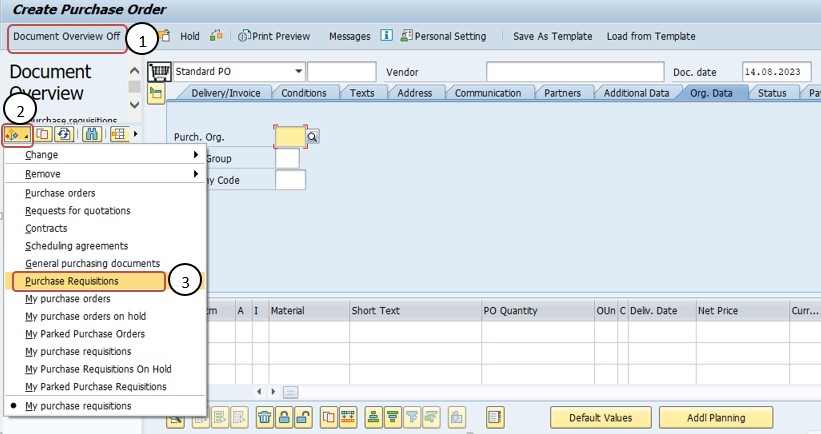
Enter Tcode ME21N (Creating PO). Run transaction ME21N to open the Create Purchase Order screen. This is the same transaction used whether you are creating a PO from scratch or adopting it from an existing requisition, so the first thing to do is make sure the screen is ready to search for requisitions rather than build a blank PO line by line.
Select Document Overview - ON. Switching on Document Overview reveals a search panel on the left side of the screen where you can look up existing Purchase Requisitions, Purchase Orders, and other purchasing documents without leaving ME21N.
Select Selection Variant. Choose the selection variant that filters the document list to the type of requisition you want to work with.
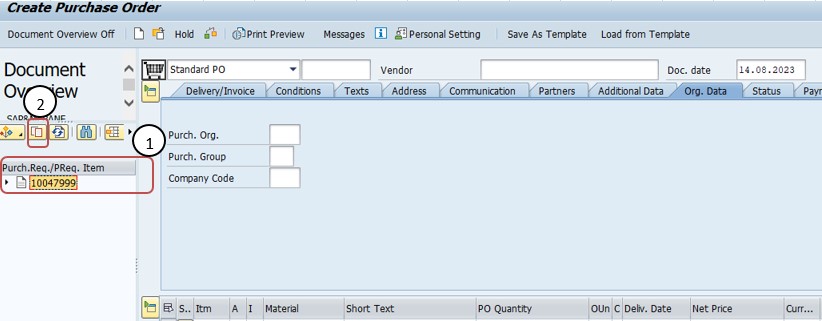
Select My Purchase Requisitions, then choose the requisition number and click Adopt. Pick the selection variant "My Purchase Requisitions" so the system shows the list of requisitions assigned to or relevant for you as the buyer. Locate the approved requisition number - for example, 0010047999 - in that list, select it, and click the Adopt button so its material, quantity, delivery date, plant, and account assignment data flow directly into the new Purchase Order rather than being retyped.
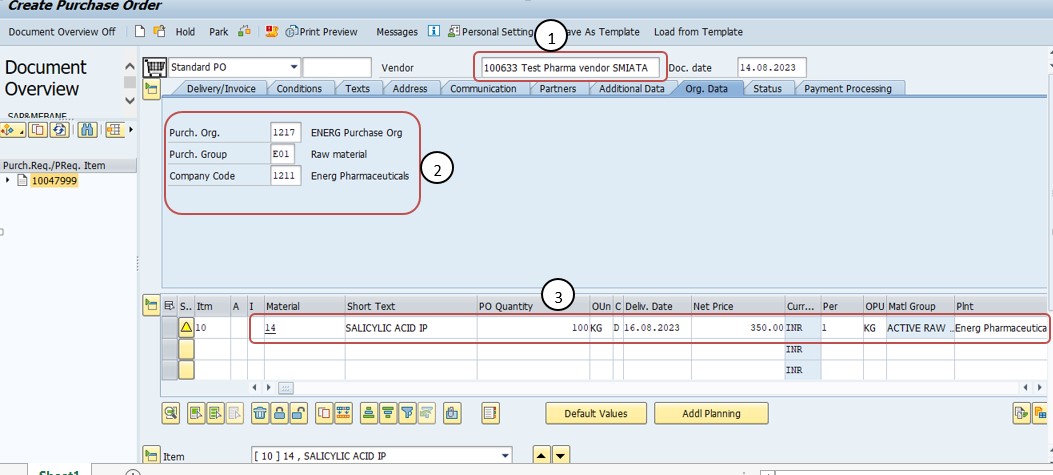
Select Vendor Name, Purchasing Org, Purchasing Group, and Company Code. With the requisition's item data adopted, complete the header-level purchasing data: enter the vendor who will supply the material, the purchasing organization responsible for the deal, the purchasing group (buyer or buying team) handling it, and the company code the Purchase Order belongs to. If Source Determination on the requisition already proposed a vendor from an existing contract or info record, this step is largely a matter of confirming that proposal rather than searching from scratch.
Check and Save. Run the Check function to validate the Purchase Order for completeness and consistency, resolve any warnings it raises, and save. Saving completes the PR to PO conversion and generates a Purchase Order number that becomes the reference document for goods receipt and invoice verification.
📋 Key Fields Involved in the PR to PO Conversion
A quick reference for the fields that matter most when converting a Purchase Requisition into a Purchase Order in ME21N.
| Field | What It Captures |
|---|---|
| Purchase Requisition Number | The approved internal request being adopted into the Purchase Order, preserving traceability back to the original need. |
| Vendor | The supplier who will fulfill the Purchase Order, either confirmed from Source Determination or selected manually. |
| Purchasing Organization | The organizational unit responsible for negotiating and issuing the Purchase Order. |
| Purchasing Group | The buyer or buying team who owns processing this particular Purchase Order. |
| Company Code | The legal entity within the organization that the Purchase Order, and its eventual invoice, will be posted against. |
| Material / Quantity / Delivery Date | Adopted directly from the requisition, these define what is being ordered, how much, and by when. |
| Account Assignment Category | Carried over from the requisition for non-stock items, determining which cost object the eventual invoice will be charged to. |
| Price / Pricing Conditions | Populated from an existing contract or info record if Source Determination found one, or entered manually if not. |
📋 Related SAP Transactions in the PR to PO Cycle
| Transaction | Purpose |
|---|---|
| ME51N | Create a new Purchase Requisition, the starting point of the PR to PO process. |
| ME52N | Change or modify an existing Purchase Requisition before it is converted. |
| ME53N | Display a Purchase Requisition without allowing changes. |
| ME54N | Release (approve) a Purchase Requisition that requires release strategy approval before conversion. |
| ME21N | Create a Purchase Order, typically by adopting an approved requisition. |
| ME22N | Change an existing Purchase Order after it has been created. |
| ME23N | Display a Purchase Order without allowing changes. |
| ME2B | Display Purchase Requisitions by requirement tracking number or other selection criteria, useful for finding requisitions to convert. |
| MIGO | Post Goods Receipt against the resulting Purchase Order once materials arrive. |
| MIRO | Perform Invoice Verification against the Purchase Order and Goods Receipt. |
❗ Common Mistakes During PR to PO Conversion
- Creating a Purchase Order from scratch instead of adopting the approved requisition, which breaks traceability back to the original approved request.
- Converting a requisition that has not yet completed its release strategy, which the system will typically block, causing confusion about why the requisition isn't appearing for adoption.
- Selecting the wrong vendor when Source Determination did not find an existing contract or info record, resulting in pricing that does not match what was expected during requisition approval.
- Leaving the purchasing organization or purchasing group inconsistent with how the requisition's plant and company code are normally handled, leading to authorization or reporting issues later.
- Skipping the Check function before saving the Purchase Order, only to discover missing pricing conditions or an unextended vendor once the PO has already been issued.
- Splitting a single requisition across multiple Purchase Orders unnecessarily, which fragments delivery tracking and can complicate goods receipt and invoice verification.
- Not verifying that the adopted quantity, delivery date, and account assignment still match current business needs if time has passed between requisition approval and conversion.
✅ Best Practices for a Smooth PR to PO Conversion
- Always adopt the approved requisition in ME21N rather than re-keying a Purchase Order, so that traceability and audit history are preserved end to end.
- Confirm that Source Determination has proposed the correct vendor, contract, or info record before accepting the default pricing on the Purchase Order.
- Double-check purchasing organization, purchasing group, and company code against organizational structure rules, especially in multi-entity or multi-plant environments.
- Run the Check function before saving every Purchase Order, and resolve any warnings rather than saving through them.
- Reconfirm delivery date and quantity with the requesting department if there has been a delay between requisition approval and PO creation, since business needs can shift.
- Keep one Purchase Order per logical delivery wherever practical, rather than splitting a single requisition across several POs without a clear reason.
- Coordinate with the vendor on lead time realism before saving, so the delivery date on the Purchase Order is one the vendor can actually meet.
📈 How the PR to PO Conversion Shapes Downstream Processes
The Purchase Order created through this conversion becomes the single reference document for everything that follows in the procurement cycle. Goods Receipt, posted through MIGO, is matched against the Purchase Order's material, quantity, and plant. Invoice Verification, performed through MIRO, checks the vendor's invoice against both the Purchase Order and the Goods Receipt in a classic three-way match. If the vendor, pricing, or quantity on the Purchase Order does not accurately reflect what was actually approved on the requisition, that mismatch tends to surface much later - as a blocked invoice, an unexpected price variance, or a goods receipt that does not tie back cleanly to what procurement intended to order.
This is why the PR to PO conversion step, despite often being a matter of a few clicks once the requisition is approved, deserves the same attention as requisition creation itself. A Purchase Order adopted carelessly - wrong vendor, mismatched account assignment, an unrealistic delivery date accepted without question - propagates that error into goods receipt and invoice verification, where it is considerably more expensive and time-consuming to untangle than it would have been to catch at conversion time.
✅ Validating the Purchase Order Before It Goes to the Vendor
Before a newly converted Purchase Order is released or sent to the vendor, it's worth running through a short validation checklist. Run the Check function and resolve any warnings or errors it surfaces. Display the Purchase Order (ME23N) and confirm that material, quantity, delivery date, plant, and account assignment all match what was approved on the original requisition. Confirm that the vendor, pricing, and payment terms are correct, especially if Source Determination proposed an existing contract or info record. Finally, confirm that the purchasing organization, purchasing group, and company code are consistent with how similar purchases are normally structured in your organization.
Skipping this validation is one of the more common reasons a Purchase Order later requires a change (ME22N) after it has already been communicated to the vendor - usually because of a vendor mismatch, an incorrect price, or a delivery date that does not reflect actual vendor lead time.
🎓 Interview-Style Questions and Answers
Q: What is the PR to PO process, and why is it split into two documents instead of one?
The PR to PO process converts an approved internal request (the Purchase Requisition) into a formal external commitment (the Purchase Order). Splitting it into two documents creates a checkpoint - budget owners and procurement can review and approve the internal need before the organization is contractually committed to a vendor.
Q: What does "Adopt" do in ME21N?
Adopt pulls the material, quantity, delivery date, plant, and account assignment data from a selected Purchase Requisition directly into a new Purchase Order, avoiding manual re-entry and preserving traceability back to the original approved request.
Q: Can you create a Purchase Order without a Purchase Requisition?
Yes, ME21N allows a Purchase Order to be created directly without referencing a requisition, but most organizations enforce a requisition-first process so that necessity and budget checks happen before any external commitment.
Q: What role does Source Determination play in the PR to PO process?
Source Determination, which happens after requisition approval, proposes where the requisitioned material can be procured from - an existing contract, an info record, or a shortlist of vendors - which then informs the vendor and pricing entered during PO creation in ME21N.
📚 Quick Glossary of Terms Used in This Guide
- Purchase Requisition (PR): A formal internal request to procure goods or services, created using ME51N, and the starting point of the PR to PO process.
- Purchase Order (PO): A formal, external commitment to a vendor, created using ME21N, often adopted from an approved Purchase Requisition.
- Document Overview: The search and navigation panel in ME21N used to look up existing Purchase Requisitions and other purchasing documents.
- Adopt: The action in ME21N that copies an approved requisition's item data into a new Purchase Order.
- Source Determination: A system function that identifies possible procurement sources - contracts, info records, or vendors - for a requisitioned material.
- Three-Way Match: The comparison of Purchase Order, Goods Receipt, and vendor invoice during Invoice Verification (MIRO) to confirm consistency before payment.
📝 Governance Around the PR to PO Process
Because the PR to PO conversion is the point at which an internal request becomes an external commitment, most organizations maintain governance around who is authorized to convert requisitions into Purchase Orders, which purchasing organizations and groups may act on which plants or company codes, and what value thresholds require additional approval before a Purchase Order can be released to a vendor. This matters because procurement, finance, and the requesting department each have a stake in the resulting Purchase Order for different reasons - procurement cares about vendor terms and pricing, finance cares about account assignment and budget impact, and the requesting department cares about whether the delivery date and quantity still match what they actually need.
Data quality governance at the conversion step matters for the same underlying reason it does everywhere else in the procurement cycle: a Purchase Order adopted quickly without confirming vendor, pricing, or account assignment tends to surface as a blocked invoice or a delivery mismatch later, once it is considerably more disruptive to fix. A clear conversion checklist, aligned to how your organization structures purchasing organizations and groups, keeps PR to PO quality consistent even as transaction volume grows.
💼 Real-World Scenario: Converting an Approved Requisition for a Production Line Component
Continuing from an earlier example, production planner Pooja Mishra at Learn Pharmaceuticals had raised a Purchase Requisition in ME51N for an urgent raw material needed to keep a production run on schedule. After procurement lead Priya Patil approved the requisition through the release strategy, buyer Anita Shah picked it up to complete the PR to PO conversion.
Anita opened transaction ME21N, switched on Document Overview, and selected the "My Purchase Requisitions" selection variant to bring up the list of requisitions awaiting conversion. She located requisition number 0010047999, selected it, and clicked Adopt, which pulled the material, quantity, urgent delivery date, plant, and storage location directly into a new Purchase Order without any manual retyping.
Because Source Determination had already flagged an existing contract with the usual raw material supplier, Anita confirmed the vendor, purchasing organization, purchasing group, and company code, all of which matched what the contract specified. She ran the Check function, which came back clean, and saved the Purchase Order. Within minutes of the requisition's approval, a formal Purchase Order had been issued to the vendor, keeping the production run on track without the delay that manual re-entry or a fresh vendor search would have introduced.
📱 The PR to PO Process in SAP S/4HANA
The underlying PR to PO conversion logic - adopting an approved requisition into a Purchase Order through ME21N - works largely the same way in SAP S/4HANA as it did in classic ECC, since both documents remain core Materials Management objects. What has evolved in S/4HANA is the availability of Fiori apps such as "Create Purchase Order" and "Manage Purchase Orders," which give buyers a more modern, list-based way to find eligible requisitions and convert them, alongside improved analytics on cycle time between requisition approval and Purchase Order issuance. Many S/4HANA implementations continue to rely on ME21N for high-volume or complex conversions, particularly where multiple requisitions need to be consolidated onto a single Purchase Order, while Fiori apps are increasingly favored for straightforward, single-requisition conversions.
🎯 Conclusion
The PR to PO process is where an approved internal need turns into a formal commitment to a vendor, and getting the conversion right in ME21N is what keeps that transition clean. Using Document Overview to find the correct approved requisition, adopting it rather than re-keying the Purchase Order, confirming vendor and organizational data against what Source Determination proposed, and running the Check function before saving are what separate a PR to PO conversion that flows smoothly into goods receipt and invoice verification from one that generates delays, price mismatches, or blocked invoices further down the line. Keep this guide handy the next time your organization needs to move an approved Purchase Requisition forward into a Purchase Order.