Work Center in SAP Production Planning (PP): How to Create a Work Center with CR01 – Complete Step-by-Step Guide
Every routing, every production order and every capacity report in SAP PP depends on one master data object: the work center. If it is set up well, scheduling is realistic, capacity load is believable and product costs are accurate. If it is set up badly, the errors appear everywhere downstream and are hard to trace back. This guide explains what a work center is, how to create one in transaction CR01 tab by tab, what each important field does, and how to avoid the mistakes beginners make most often. If you run into any errors while following along, feel free to send a screenshot to pramod@learntosap.com for help.
🔧 Work Center in Production Planning (PP): Overview
In SAP Production Planning, a work center represents a place where manufacturing activities are carried out. It can be a single machine, a production line, an assembly station or a group of workers who perform a particular task. Work centers are critical for planning and execution because they determine where and how work is performed, how long it takes and what it costs.
| Item | Value in This Tutorial |
|---|---|
| Master data object | Work center |
| Create / Change / Display | CR01 / CR02 / CR03 |
| Plant | 1254 |
| Work center | WM PRAM |
| Work center category | 0001 |
| Cost center | 1006 |
The values in the table come from the example used in the screenshots. Replace them with the plant, work center name, category and cost center that exist in your own system.
📑 What You Will Learn in This Guide
- What a work center is
- Why work centers matter
- Before you create one
- Menu path and transaction codes
- Step 1: Basic data
- Step 2: Default values
- Step 3: Capacities
- Intervals and shifts
- Step 4: Scheduling
- Step 5: Costing
- Worked capacity example
- Real-world scenario
- Common mistakes
- Troubleshooting
- Frequently asked questions
✅ What Is a Work Center in SAP PP?
A work center is a master data record that describes a resource used to perform operations. Think of a bottling machine, a welding station, a packing line or a team of quality inspectors. In SAP, each of these can be set up as a work center so that the system knows where the work happens, when it is available and how much it costs per hour.
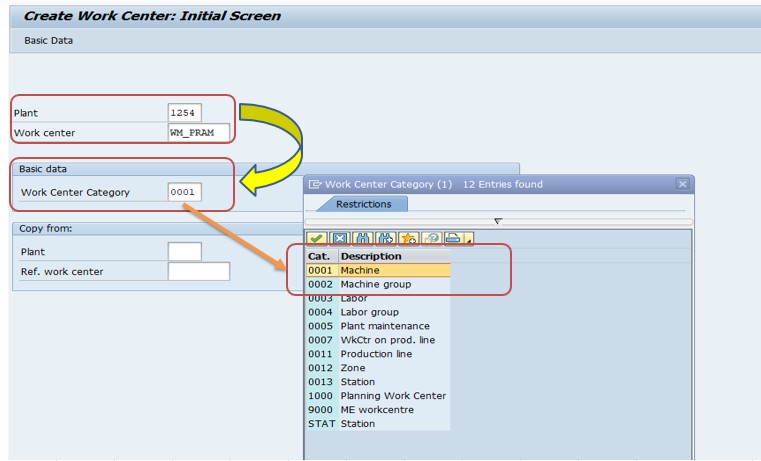
A work center is identified by the plant it belongs to and a short name of up to eight characters. In our example the plant is 1254 and the name is WM PRAM. The work center category, 0001 here, groups work centers by kind and decides which screens and default settings the work center uses. Your company defines its own categories in Customizing, so the meaning of 0001 should be confirmed in your system.
The work center does not do anything by itself. It becomes useful when it is assigned to the operations of a routing or a production order. At that moment the data stored in the work center, such as the control key, the formulas and the cost center, flows into the operation and drives scheduling, capacity planning and costing.
📋 Why Work Centers Matter: What They Control
A work center holds the information that SAP needs in four areas of production planning. The table shows how each area uses it.
| Area | What the Work Center Provides |
|---|---|
| Scheduling | Formulas and standard values to calculate the duration of each operation, and queue times before and after it. |
| Capacity planning | Available capacity per day, shifts, breaks and utilization, so that load can be compared with supply. |
| Costing | The cost center and activity types used to value machine and labor time in product costing. |
| Operation control | Default values such as the control key, which decides whether an operation is scheduled, costed or confirmed. |
Because so many processes depend on it, a mistake in the work center spreads quickly. A wrong cost center leads to wrong product costs. A missing capacity leads to empty capacity reports. A wrong formula leads to production orders that finish earlier or later than reality. Careful setup is worth the time.
✅ Before You Create a Work Center: Checklist
A few minutes of preparation prevent most errors during creation.
- The plant exists and is set up for production planning.
- The work center category you plan to use exists in Customizing.
- The cost center exists in the controlling area to which the plant belongs, and is valid for the dates you need.
- Activity types for machine and labor time exist if you want production costs to be calculated.
- The factory calendar is assigned to the plant, because capacity and scheduling use it.
- The naming convention of your company is known, so that the new work center fits the existing ones.
- You have authorization for CR01 in the plant, or a request is ready for the master data team.
📝 Menu Path and Transaction Codes
Follow these steps to start. The same screen can be reached through the SAP menu or directly with a transaction code.
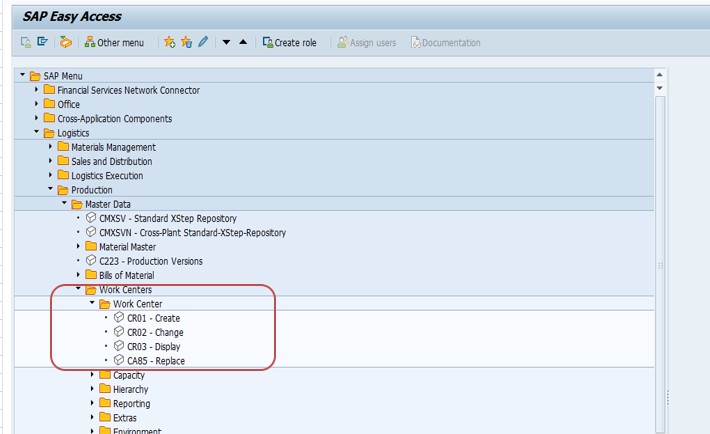
Path in SAP menu: SAP Menu → Logistics → Production → Master Data → Work Centers → Work Center → Create.
Transaction code: run CR01 to create a work center.
| Transaction | Purpose |
|---|---|
| CR01 | Create a work center. |
| CR02 | Change a work center. |
| CR03 | Display a work center. |
On the initial screen enter Plant 1254, Work center WM PRAM and Work center category 0001, then press Enter. If a similar work center already exists, you can use the copy option to take it as a template, which saves time and keeps settings consistent.
🔧 Step 1: Basic Data Tab
The Basic data tab holds the general information about the work center. It is the first screen you see after the initial entry.
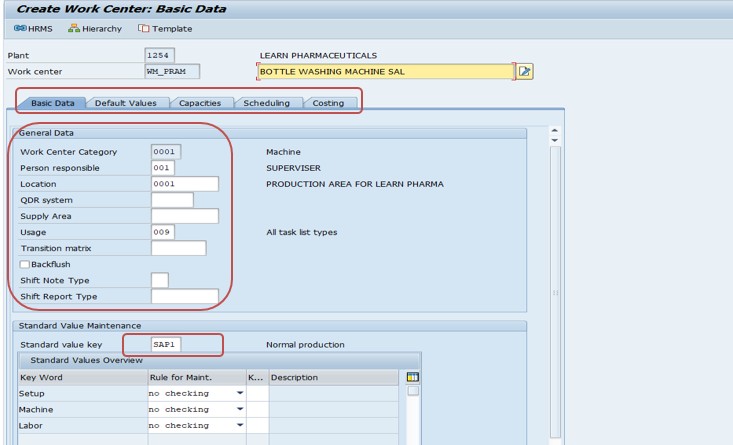
| Field | Example | Meaning |
|---|---|---|
| Description | Short text | A clear name that planners will recognize in lists and reports. |
| Person responsible | 001 | The name or ID of the person responsible for the work center. |
| Usage | 009 | Determines in which applications the work center can be used, for example production or maintenance task lists. |
| Standard value key | PP01 | Links to the operations and decides which time values are calculated. |
The person responsible is more than a label. It is used in selection and reporting, and it tells colleagues who to ask when something is unclear. The usage controls where the work center can be assigned. If the usage does not allow the task list type you want, SAP will not accept the work center in that routing. The standard value key decides which values, such as setup, machine and labor time, are entered in the operation.
🔧 Step 2: Default Values Tab
Default values are proposed in every operation where this work center is assigned. They save typing and make sure that operations are set up in a consistent way.
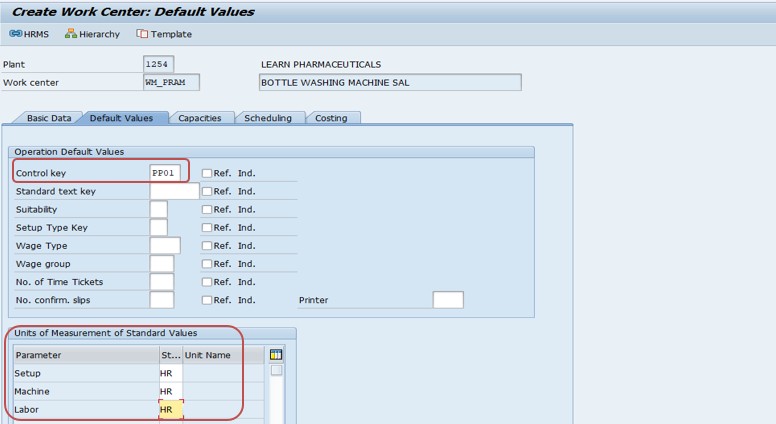
| Field | Example | Meaning |
|---|---|---|
| Control key | PP01 | Specifies which tasks are performed during the operation, such as scheduling, costing and confirmation. |
| Standard values | HR | Sets the default unit for operation durations, for example hours for setup time and machine time. |
The control key is one of the most important entries on the tab. An operation with a key that does not allow costing will not be costed. An operation with a key that does not allow confirmation cannot be confirmed. Always check the control key against how the work center will be used.
The unit for standard values avoids the mix-up of minutes and hours. If routings are maintained in minutes but the default says hours, times will be wrong by a factor of sixty. Decide the unit once and apply it everywhere.
🔧 Step 3: Capacities Tab
The Capacities tab defines how much work the work center can do. This is the base for capacity planning and for the load shown in capacity reports.
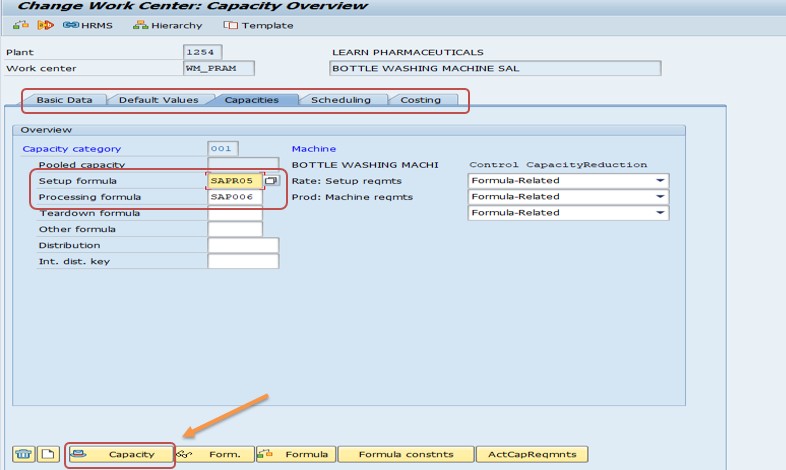
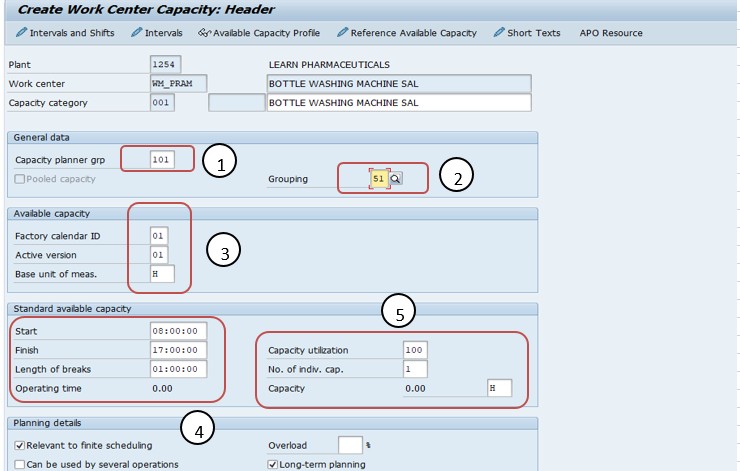
Select the Capacities tab and create the capacity you need. The main entries are:
- Capacity category: defines the type of capacity, for example machine or labor. A work center can have several categories, for example one machine and two workers.
- Available capacity: specifies working hours per day, the shifts and the operating time.
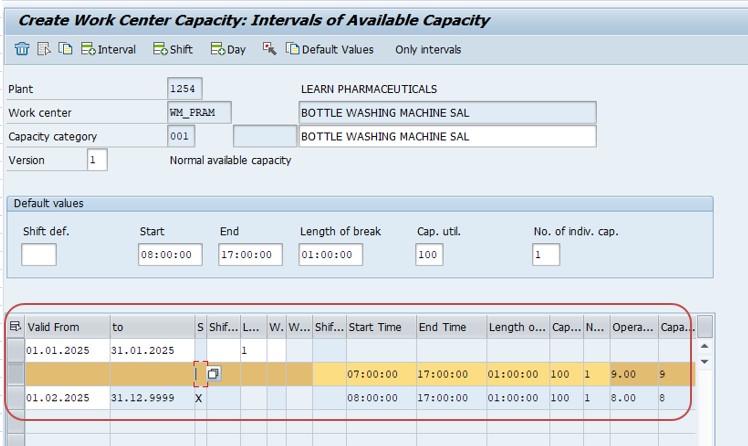
- Intervals: allow you to define variations in capacity, such as holidays, maintenance downtime or a different shift pattern for a period.
Capacity planning compares two numbers: the capacity available here, and the capacity required by operations in planned and production orders. If the available capacity is missing or wrong, the comparison is meaningless, even when every order is perfect.
📅 Intervals and Shifts: Defining Available Capacity
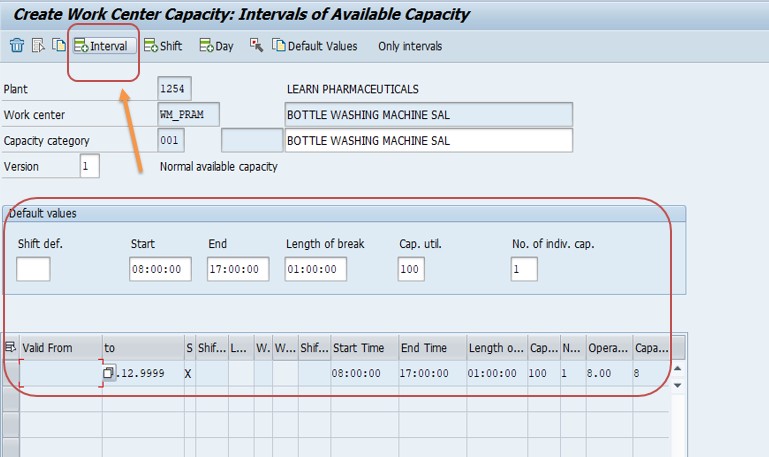
Select the Intervals button on the capacity screen to open the detail where daily availability is defined.
| Field | What It Defines |
|---|---|
| Start and finish time | The time the work center starts and ends work each day. |
| Length of breaks | The time deducted for breaks and not available for production. |
| Number of individual capacities | How many machines or workers work in parallel. |
| Capacity utilization rate | The percentage of the time that is realistically used, to allow for setup waste and small stops. |
| Factory calendar | The days on which the work center works, excluding weekends and holidays. |
| Base unit of measure | The unit in which the capacity is expressed, usually hours. |
Intervals are valid for a period. If a plant shuts down for maintenance for two weeks, you can define an interval with reduced capacity for that period instead of changing the base setting. This keeps the history clean and the plan realistic.
🔧 Step 4: Scheduling Tab
The Scheduling tab defines the parameters that affect the dates of production orders.
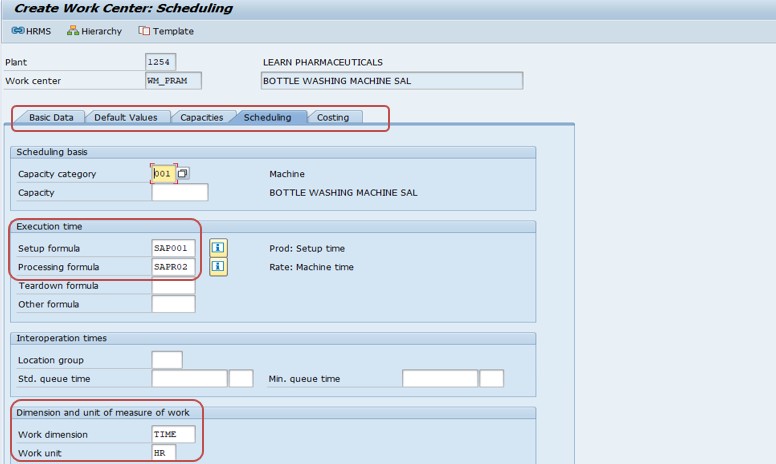
- Formulas: used to calculate operation times, such as setup, machine and labor time, from the standard values entered in the routing.
- Operation duration: defines the relationship between the capacity and the duration of the operation, so that SAP knows which capacity category determines the time.
- Queues: specify buffer times such as queue time before and wait time after the operation, to reflect real waiting in production.
Queue times are often underestimated. Material rarely goes from one operation to the next the moment the first finishes. A realistic queue time protects the schedule from being too optimistic, while a queue time that is too long makes orders start earlier than necessary and inflates work in process.
🔧 Step 5: Costing Tab
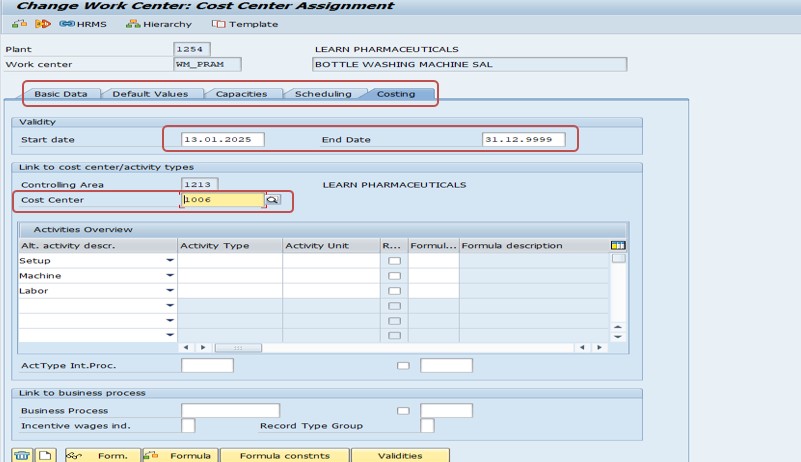
The Costing tab holds the cost-related parameters for the activities performed at the work center. This is where production meets controlling.
| Field | Example | Meaning |
|---|---|---|
| Cost center | 1006 | Links the work center to the cost center that captures its costs. |
| Activity types | Machine, labor, setup | Define the services the work center provides and the rates used to value them. |
| Formula keys | As defined | Link the operation values to the activity quantities used in costing. |
When a routing operation uses this work center, SAP multiplies the operation time by the activity price from the cost center and activity type. The result becomes part of the product cost. If the cost center link is missing, or the activity prices are zero, products will appear cheaper than they really are.
After you have entered all tabs, run the check and then save. SAP confirms that the work center was created, and you can display it in CR03 to verify the entries.
📋 Work Center Tabs at a Glance
| Tab | Purpose | Key Entries |
|---|---|---|
| Basic data | General information | Person responsible, usage, standard value key |
| Default values | Values proposed in operations | Control key, standard value unit |
| Capacities | Available capacity | Capacity category, shifts, intervals |
| Scheduling | Date calculation | Formulas, operation duration, queue times |
| Costing | Cost determination | Cost center, activity types |
💡 Worked Example: From Capacity to Operation Duration
Numbers make the connection between the tabs easier to understand. Assume work center WM PRAM runs one machine with this setup.
| Item | Value |
|---|---|
| Start and finish time | 07:00 to 15:30 |
| Break | 30 minutes |
| Number of individual capacities | 1 |
| Capacity utilization | 90 percent |
The gross working time is 8.5 hours. After a 30 minute break the net time is 8 hours. With a utilization of 90 percent, the available capacity per day is 7.2 hours.
Now a production order arrives for 100 pieces. The routing says the setup takes 30 minutes and the machine needs 3 minutes per piece. The required machine time is 30 minutes plus 300 minutes, that is 330 minutes or 5.5 hours. This order alone uses 5.5 of the 7.2 available hours, so about 76 percent of one day. A second order of the same size cannot finish on the same day, and SAP will schedule it for the next available day or show an overload in capacity planning.
The same hours are then valued using the activity price of the cost center. If the machine hour rate is 800, the machine cost of the order is 5.5 times 800, or 4,400. This simple calculation shows how a few entries in the work center decide dates, load and cost at the same time.
💼 Real-World Scenario: A New Packing Line for a Pune Plant
This is an illustrative example based on a typical project. A food manufacturer in Pune installed a new packing line and asked its SAP PP consultant to make it available for planning before the first production run. The consultant used CR01 to create the work center in plant 1254, copied the settings from the old packing line, and changed only what was different.
She entered the new shift pattern with a longer break, set the utilization to 85 percent because the line was new and not yet stable, and assigned a new cost center so that the line costs could be followed separately. The production planner then updated the routings of the packed products, replacing the old work center with the new one.
In the first week, capacity reports showed the line at an overload on two days. Instead of ignoring it, planners moved two orders and discussed a second shift with the plant manager. Three months later the line was stable, and the utilization was raised to 92 percent. The change was made in the work center in a few minutes, and every later schedule used the new value. The example shows why capacity settings are best treated as living data that is reviewed regularly.
❗ Common Mistakes When Creating a Work Center
- Leaving out the capacity, so that capacity reports show nothing for the work center.
- Forgetting the cost center, so that production costs are incomplete.
- Using a control key that does not allow costing or confirmation.
- Mixing minutes and hours in the standard value unit.
- Setting the utilization at 100 percent, which makes every plan too optimistic.
- Using inconsistent names, so that planners cannot find the right work center.
- Creating a new work center for each small difference instead of using shifts or intervals.
- Changing a live work center without telling the planners who depend on it.
🔧 Troubleshooting: Common Work Center Problems
The work center cannot be assigned in the routing
Check the usage on the Basic data tab. If the usage does not include the task list type, SAP rejects the assignment.
Capacity reports show no load or no supply
Check that a capacity category exists, that the shifts and the factory calendar are maintained, and that the operation's capacity category matches the one in the work center.
Production orders are scheduled with wrong durations
Check the formulas on the Scheduling tab, the unit of the standard values, and the queue times. Compare a simple order by hand with the result in SAP.
Product costs are too low or zero
Check that the cost center is assigned, that the activity types are valid, and that activity prices have been planned for the period.
The cost center cannot be entered
The cost center may not exist in the controlling area of the plant, or its validity may not cover the date. Check the cost center in the controlling master data.
You cannot change the work center
You may lack authorization for CR02 in this plant, or another user may have the work center locked. Ask the master data team, or wait until the lock is released.
✅ Best Practices for Work Center Master Data
- Agree a naming convention and apply it to all plants.
- Copy from a good reference work center and change only the differences.
- Keep a document that records the capacity, shift pattern and rate for each work center.
- Review capacity and utilization at least once a year and after every major change in production.
- Use intervals for temporary changes instead of overwriting base settings.
- Check the cost center and activity prices every time the plan for the new year is prepared.
- Retire work centers that are no longer used by blocking them, not deleting them.
- Test a new work center with a sample routing and a test order before releasing it.
🔒 Authorization Considerations
Work center changes affect planning and costing across the plant, so access is normally controlled by plant. Many companies let production planners display work centers with CR03 but reserve CR01 and CR02 for a small master data team. If you cannot create one, send your request with the plant, name, category, capacity, shift pattern and cost center, so that the team can act without further questions.
📱 Work Centers in SAP S/4HANA
The work center remains a core master data object in SAP S/4HANA production planning. In on-premise releases the classic transactions CR01, CR02 and CR03 are still available, and the tabs and the logic described here apply. SAP also provides Fiori apps for working with work centers in some releases and editions. Apps and options change with each release, so check which ones are available in your own system.
If your company is moving to S/4HANA, review the work center master data before migration. Remove unused records, correct cost center links and check capacities. Clean data makes the move smoother and the first plans more trustworthy.
📋 Quick Create Checklist
- Prepare the plant, category, cost center and activity types.
- Run CR01 and enter the plant, the work center name and the category.
- Fill the Basic data tab: person responsible, usage and standard value key.
- Fill the Default values tab: control key and standard value unit.
- Create the capacity with category, available capacity and intervals.
- Fill the Scheduling tab: formulas, operation duration and queue times.
- Fill the Costing tab: cost center and activity types.
- Check, save and display the result in CR03.
- Test with a sample routing and production order.
📋 Related SAP Transactions
| Transaction | Purpose |
|---|---|
| CR01 / CR02 / CR03 | Create, change or display a work center. |
| CA01 / CA02 / CA03 | Create, change or display a routing that uses the work center. |
| CS01 | Create a bill of material. |
| CO01 | Create a production order. |
| KS01 | Create a cost center. |
| KL01 | Create an activity type. |
🎓 Interview-Style Questions and Answers
Q: What is a work center?
A master data object that represents a machine, line or group of people where operations are carried out.
Q: Which transactions are used for work centers?
CR01 to create, CR02 to change and CR03 to display.
Q: What does the control key do?
It decides which functions an operation uses, such as scheduling, costing and confirmation.
Q: Why is the cost center needed?
To collect costs and to value machine and labor time in product costing.
Q: How do you model a temporary capacity reduction?
With an interval or shift definition valid for the period, not by overwriting the base capacity.
Q: What happens if the capacity is missing?
Capacity planning cannot compare load and supply, and reports show no useful result.
📚 Quick Glossary
- Work center: A place where operations are performed, such as a machine or a group of workers.
- Work center category: A grouping that determines screens and defaults.
- Control key: Defines what an operation may do, such as scheduling or costing.
- Standard value key: Defines which time values are entered in an operation.
- Capacity: The amount of work a work center can perform in a period.
- Utilization rate: The share of available time realistically used.
- Queue time: Waiting time before an operation starts.
- Activity type: A service, such as machine hours, valued at a rate in the cost center.
🎯 Conclusion
A work center is a small record with large consequences. Create it in CR01 with care: set the basic data, define sensible default values, describe the real capacity with shifts and intervals, give scheduling realistic formulas and queue times, and link it to the right cost center. Check it, save it, and test it with a sample routing and order. Review the settings from time to time, because the shop floor changes and the master data should follow. If you get stuck at any step, send the details to pramod@learntosap.com and we will help you find the answer.